For tea lovers, choosing the right teaware is crucial to enhancing the tea-drinking experience. Gaiwan and teapots, two of the most common teaware options, may appear similar in function, but they actually differ significantly. Below, we compare them across five key dimensions to help you quickly find the right teaware for you.
1. Material: Porcelain vs. Pottery: The Textures Are Worlds Apart
- Gaiwan: mainly made of porcelain, with outstanding appearance
Mainstream gaiwan bowls are often made of porcelain , such as celadon, white porcelain, and blue-and-white porcelain. Porcelain boasts a smooth, delicate surface and a bright, translucent color. White porcelain perfectly captures the true color of the tea, celadon offers a gentle, jade-like texture, and blue-and-white porcelain offers both aesthetic appeal and cultural appeal, making it a perfect choice for tea lovers seeking both aesthetics and practicality.
- Teapots: mainly pottery, with various styles
Teapots are made from a wider variety of materials, with pottery (such as purple clay and stoneware) being the most representative. Pottery tends to have a darker color (such as the ochre of purple clay and the gray-brown of stoneware) and features fine pores on its surface. While not as striking as porcelain, pottery offers a wide variety of shapes (from the rounded Xishi pot to the upright Shipiao pot) and can develop a patina with long-term use, making it suitable for tea lovers who prefer a retro style or value the growth potential of their teaware.
2. Brewing Experience: Flexible and Intuitive vs. Stable and Worry-Free
- Gaiwan: High degree of freedom, suitable for those who want to control
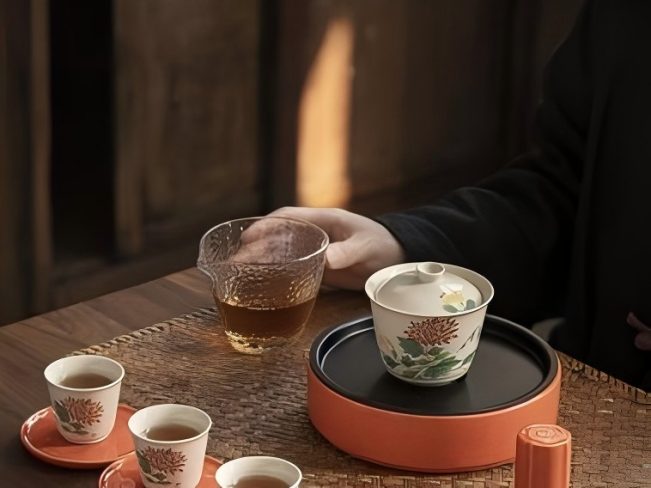
The gaiwan is composed of three parts: the lid, the bowl, and the tray. It has no fixed handle, so you can hold the edge of the bowl directly when brewing (be careful to avoid burns). Its advantages are:
- Intuitive and controllable : Transparent or light-colored porcelain bowls allow for clear observation of the tea soup color and tea leaves' expansion (i.e., "leaf bottom"), making it easy to adjust the brewing time.
- Flexible water discharge : The tilt angle can be freely controlled, and the water discharge speed is fast. It is suitable for green tea, black tea and other teas that need to be "brewed and discharged quickly", and is also often used in professional tea evaluation.
- Teapot: Easy to operate, suitable for those who love to worry less
The teapot has a built-in handle, which makes it stable to hold and not burn your hands. The brewing process is more fixed: add tea, pour water, cover the lid, and pour tea, without having to adjust your posture frequently. However, its disadvantages are also obvious:
- Unintuitive : The teapot body blocks the view of the tea soup and tea leaves, and beginners may experience astringent tea soup due to long brewing time.
- The water flows out slowly : The speed at which water flows out of the spout is affected by the shape of the teapot. It is suitable for sharing with multiple people (multiple cups can be poured at a time), but the pace is slow, which is more suitable for leisurely tea tasting.
3. Applicable Tea: “Universal Player” vs. “Specialist Player”
- Gaiwan: versatile and suitable for all kinds of tea, the first choice for high-flavor tea
Porcelain is non-absorbent and won't absorb tea aroma, preserving the tea's original flavor to the greatest extent possible . It's particularly suitable for highly aromatic teas like green, black, and yellow teas. For example, brewing Longjing tea in a white porcelain covered bowl reveals a distinct bean aroma, while brewing Keemun black tea enhances its floral and fruity notes.
- Teapot: Material determines suitability, so choose the right teapot for your tea
The adaptability of a teapot is greatly affected by its material, so it needs to be selected accordingly:
- Zisha teapot : It has adsorption properties and is suitable for brewing oolong tea (such as Tieguanyin) and Pu'er tea, which are highly fermented and have a strong flavor. It can neutralize the bitterness and make the taste more mellow.
- Coarse earthenware pot : good air permeability, suitable for brewing old white tea and rock tea, which can enhance the mellowness of the tea soup;
- Porcelain teapot : Although it has no adsorption properties, it is more suitable for brewing black tea (such as Anhua black tea) which is resistant to boiling and steeping because the tea leaves are released slowly.
4. Difficulty of Cleaning: Easy to Wash vs. Requires Care
- Gaiwan: simple structure, clean without dead corners
The gaiwan is split into just three parts, and the porcelain surface is smooth with no hidden crevices. After drinking tea, simply rinse with clean water, no extra scrubbing required, making it perfect for both lazy and busy tea lovers.
- Teapot: complex structure, easy to hide tea stains
The interior of a teapot includes a spout and a strainer (in some styles). This is especially true of purple clay teapots, where tea residue can easily accumulate. If left uncleaned, tea residue can accumulate, affecting the taste of your next brew and damaging the teapot's patina. This requires careful scrubbing with a soft-bristled brush, which can be costly.
5. Style and Ritual: Minimalism vs. Elegance
- Gaiwan: Focus on the tea itself, a representative of minimalist style
The design of the gaiwan focuses more on "functionality" without any unnecessary decoration. The brewing process is simple and direct. It is suitable for minimalists who pursue "tea-based" life, and also suitable for novices to quickly master tea brewing skills.
- Teapot: full of ritual sense and strong tea ceremony atmosphere
The shape and material of the teapot have cultural attributes, and the process from adding tea to pouring tea is more "ritualistic" - for example, when using a purple clay teapot to brew Pu'er, the steps of warming the pot and washing the tea can make the tea drinking process more ritualistic, which is suitable for tea lovers who like slow life and pay attention to the atmosphere of the tea ceremony.
Summary: How to choose? Depends on your needs!
- Choose a gaiwan : If you are a beginner, prefer flexible tea control, love fragrant tea, or seek simplicity and cleanliness, a gaiwan is the first choice;
- Choosing a teapot : If you prefer a retro style, value a sense of ritual, often brew fermented tea, or need to share with many people, a teapot is more suitable.
There is no good or bad tea set, the best one is the one that suits you - why not try two tea sets yourself according to the tea you usually drink and the occasions when you drink tea, and find your "birthday tea set"!